Thursday, December 16, 2010

Jeremy West - Brain Gains


(Click picture to go to video)

I. The website is from Toronto, Ontario, Canada. It is "Canada's Online Information Source," home of CBC News, Sports, Radio, and Entertainment. The video is part of The National, CBC's "nightly news and current affairs program." The news piece is about two schools -- City Park Collegiate in Saskatoon, Saskatchewan, Canada and Naperville Central High School in Naperville, Illinois, United States.

II. I thought the news piece was very interesting. I have heard that exercise was associated with learning, but I never seen or heard of actual studies that have been done. It is pretty amazing what exercise can do for you. Everyone knows that exercise is good for you physically, but I'm sure a lot of people don't know the psychological and emotional benefits that it brings. I was surprised how the two students that were featured in the news piece felt about it even though they come off as kids that would think they were too cool to participate in it. The increases in both of their education and behavior seem to be profound.

III. We probably don't hear anything about the physical education teacher being involved in the experiment because he/she is probably stuck in the old way of teaching physical education and only focuses on the students who want to participate instead of everyone in the class.

I will ensure that my physical education program will benefit both the students and the faculty of my school by teaching different units besides the traditional sports to make class fun and different to make the students excited and anxious about what they will be doing in class. By everyone in class participating, their heart rates will be up and will promote the release of nerve growth factors such as BDNF. This will release stress and enhance the students' ability to focus in their other classes.

IV. The main benefits of the program were improvement in behavior, attention, and school. The students improved a full grade level in reading, writing, and math. Barney improved 20% in reading and 400% in
comprehension. Dustin improved 25% in reading, 25% in math, and 30% in comprehension. I was somewhat surprised by the findings. Both of the students improved profoundly in certain subject areas. I would be interested to see how much students that have average scores in those areas would improve compared to these students.

These outcomes are similar to the New York State Physical Education Standards. Standard 1 states "Students will have the necessary knowledge and skills to establish and maintain physical fitness, participate in physical activity, and maintain personal health." In the news piece, the program was expanded to most of the students in grades 8 and 9 to 20 minutes of exercise 3 days per week. This satisfies Standard 1. Standard 2 states "Students will acquire knowledge and ability necessary to create and maintain a safe and healthy environment." This standard is touched on because the behavior of the students improved and most likely resulted in a safer and healthier environment. Standard 3 states "Students will understand and be able to manage their personal and community resources." Barney realized the benefits of the program and said he realized he was getting smarter resulting in him to rethink where he wanted to go in life. As a result, students would be more likely to continue exercising outside of school.

V. BDNF is a nerve growth factor that is released in the brain. It helps preserve and strengthen nerve cells as well as relieve stress. This relates to physical education and learning because BDNF is released during sustained aerobic exercise when the heart rate is between 65-75% of its maximum for at least 20 minutes. A physical education class should satisfy these requirements, and in return, nerve cells in the brain are strengthened and preserved resulting in better learning.

Two books that currently outline the benefits of exercise and learning are Spark: The Revolutionary New Science of Exercise and the Brain by Dr. John Ratey and The Kinesthetic Classroom: Teaching and Learning Through Movement by Traci Lengel and Mike Kuczala.


Part 1C - The goal for us as physical educators is to get our students to be recreationally competent in 6 activities and proficient in 3 activities in 3 different activity categories (6+3/3). There are 9 categories: team passing, net/wall, target, striking/fielding, aquatics, dance & aesthetic, outdoor, personal performance, and fitness. Learning Standard #1A states "Students will perform basic motor and manipulative skills. They will attain competency in a variety of physical activities and proficiency in a few select complex motor and sports activities." In my opinion, the recommended regent's level for this standard should be 90% of the senior class. I don't think it's very difficult to be competent in 6 activities. It is somewhat more difficult to be proficient in 3 activities. It's the fact that it has to be across 3 different categories that would make it a little difficult for some students. That is why I chose 90% instead of something higher. However, 90% is a very reasonable level. If students are taught various activities in each category throughout their entire high school career, students should be able to achieve this mark.

Learning Standard #1B states "Students will design personal fitness programs to improve cardiorespiratory endurance, flexibility, muscular strength, endurance, and body composition." In my opinion, the recommended regent's level for this standard should be 99% of the senior class. I would recommend 99% instead of 100% because that will only lead to failure. Throughout each students time in high school, they would all have taken not only physical education but health as well. After taking both of these classes, there really isn't any reason why students shouldn't be able to develop their own fitness program. They would learn about different activities they could incorporate into their program through physical education class and well as some health benefits, and health class would give them all the information they would need to know about health and fitness.

Thursday, December 9, 2010

Lab D Reflection

My lesson for Lab D was on Sport Stacking, more commonly known as Cup Stacking. Sport Stacking is not your traditional physical education class unit, but it has gained so much popularity in physical education classrooms all over the country. Some people may think that Sport Stacking shouldn't be a unit in physical education. They think that it isn't a physical activity, but boy, are they wrong! It satisfies many of the NASPE Standards. For example, Standards 1 and 2 are satisfied by the students in their ability to comprehend and perform the many different stacks. Sport Stacking has many benefits, including muscle endurance on the health-related fitness side. You wouldn't believe how tired your arms can get from continuously stacking. It also is a great way to develop and maintain hand-eye coordination, reaction time, and speed.


I was quite disappointed with my teaching in the lesson. I started off well, but Dr. Yang threw me a curveball with Andy acting as a blind student and I got caught looking. I did my best to regroup, but it threw me off a lot. I ended up forgetting to mention my visual aid and the cues to the 6-6 stack that I was teaching. I waited a couple days to clear my head of all of the negative thoughts that tend to fill your head right after an event like this happens and thought about what I could have differently in that situation. Things like that occur in a physical education classroom, and I need to learn how to properly deal with it.


Lab D Videos:


Lesson Plan

Task Progression Sheet

Assessment

Block Plan

Scope & Sequence

Transcription

Time Coding Form

Feedback Analysis Form

Content Development

Self C-9 Form

Lab D Packet

Monday, November 29, 2010

2010 NYS AHPERD Conference

I went to the NYS AHPERD Conference at Turning Stone Resort & Casino from November 18-20. I also attended our mini-conference on campus so I figured it was going to be similar to that but just on a slightly bigger scale. It was like our mini-conference but on a MUCH bigger scale. There were so many presentations; it was hard to choose which ones to go to. First off, the keynote was awesome. The speaker was Coach Jim Johnson from Greece Athena basketball. He is the coach of the autistic player "J-Mac" as seen on ESPN. I loved his presentation. As for the sessions, I tried attending both coaching and physical education sessions because I am very interested in both.

Here are some of the sessions I attended:

- Education of a Sports Season
- Moral Integrity in Sport and Athletics/Beyond the Gymnasium Doors (jumped back and forth)
- The Role and Responsibility of Educators in Youth Sports
- Managing Relationships: A Key to Success in Athletics
- Wanted: Teachers Thinking About Becoming a Director
- Intentionally Developing Character in Your Student/Athletes

Overall, it was a fun time, and it got me thinking about new ideas and rethinking old ones. It is definitely worth it, and I look forward to going again next year!

Thursday, November 4, 2010

Lab C Reflection


The above video is my fifth time teaching. For my Lab C, I taught a lesson on volleying and passing in the Malaysian sport called sepak takraw, more commonly known as kick volleyball. I will embed a video of sepak takraw on the bottom on this post. I was very happy with how my Lab C teaching lesson went. It was my best teaching performance yet. I felt it. It was the complete opposite of how I felt after my Lab B2. I felt confident, and the extra five minutes really helped me utilize everything on the C-9 form. It makes me realize how far I've come so far. I got all of my points on the C-9 form and some bonus points as well for incorporating scaffolding, teaching by invitation, and pinpointing.

Some things that I still need to work on are feedback and time coding. I still haven't provided feedback for over 50% of the class. I am only providing feedback to about 25% of the class. I am still spending a lot of time instructing as well. I did spend more time in activity than I usually do, but it isn't over 50% like it is encouraged.

Even though I had a good day of teaching I know I still have quite a bit to work on. I hope to continue my recent success into my Lab D where I will be teaching cup stacking, which is different but should definitely be fun.

Lesson Plan

Task Progression Sheet

Transcription

Time Coding Form

Feedback Analysis Form

Content Development

Thursday, October 28, 2010

Lab B2 Reflection


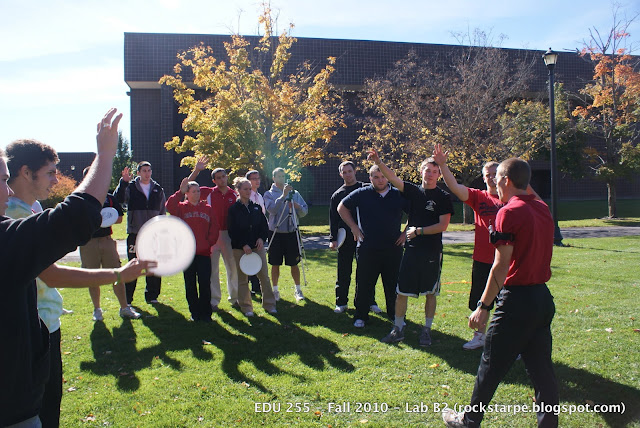
The above video is my fourth time teaching. Right after I was finished teaching my lesson on leading with the backhand pass in ultimate frisbee, I was very disappointed with how it went. I forgot things that I wanted to say just minutes after going over it with Dr. Yang. I seem to always draw a blank as soon as I start my lesson for some reason. I'm optimistic that this occurrence will cease to exist over time. After some time to think it over it didn't go as badly as I thought. One of the problems I put upon myself was my insistence that I incorporate everything on the C-9 form into my lesson. That is one of the reasons why I probably forget things because I try to put too much stuff into my short and simple lesson. Another thing that this affects is my time coding within my lesson. Because I try to incorporate everything on the C-9 form in the short time that I have, I spend too much time instructing and not enough time in activity.

Within my lesson I incorporated the three domains of teaching. The class ran and caught the disc for the psychomotor domain. This would be NYS Learning Standard 1a and NASPE Standard 1. For the cognitive domain, I asked the class to recall the cues to the backhand pass in the beginning of the lesson and to tell me one of the common mistakes while leading a partner with the backhand pass at the end of the lesson. This would fit in NYS Learning Standard 1a as well and NASPE Standard 2. The last domain, the affective domain, was incorporated into the lesson by having the students work in groups of three. They also had to interact while performing the activity. This would fit into NYS Learning Standard 2a and NASPE Standard 5.

The following is a list of things that I incorporated in my lesson:

- Introduction: I introduced myself.
- Hook: I asked how many people had brothers or sisters and then if anyone was an only child. I told the only child that it was their lucky day because we were all going to be brothers and sisters.
- Cues: I had the class think back and recall the cues to the backhand pass.
- Demonstration: I demonstrated what I wanted the students to do.
- Common faults: I told the class some common mistakes when leading a partner with the backhand pass.
- Safety statement: I reminded them to be alert.
- Feedback: I walked around and gave feedback. I provided some general and skill feedback that was congruent to my lesson.
- Checking for understanding: I asked them to tell me a common mistake when leading a partner with the backhand pass.

The following is a list of things that I didn't do well in my lesson:

- Visual aid: I made a visual aid but forgot about it.
- Signal for attention: I didn't tell the class what my signal for attention was.
- Statement of expectation: I didn't provide one.
- Demonstration: I only demonstrated once and not really at full speed.
- Common faults: I didn't demonstrate the common faults, only told the class.
- Feedback: I provided feedback to less than 50% of the class.

Transcription

Time Coding

Feedback Analysis


Sunday, October 10, 2010

SUNY Cortland Mini Conference

I attended the Leadership: The Power to Empower Players session with Kathy Taylor and the Special Olympics Certification Workshop session. I only got to sign into the first one, however, because the second one didn't have a sign in sheet for some reason.

In the Leadership session, Coach Taylor discussed ten tips on developing great team leaders. Some of the tips were to establish a relationship with your players; set goals and write them down; lead with questions and suggestions, not answers; and be a good role model.

In the Special Olympics session, Bill Collins discussed how the Special Olympics work and what has to be done to become a certified coach. Some of the things that he mentioned that I didn't know about was that the special Olympic athletes do train for the sport they participate in. All of the athletes' entry and travel are paid for by the Special Olympics. There are over twenty sports over three seasons as well.

It was an interesting day and definitely worth going to. I look forward to the next conference.

Wednesday, October 6, 2010

Lab B1 Reflection


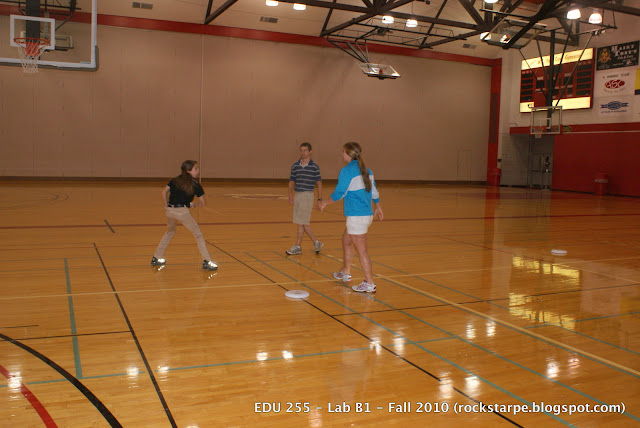
The above video is my third time teaching a four minute lesson in EDU 255. It didn't go as smoothly as my previous lesson. I can make the excuse that I had presentations and work in other classes, but the fact is I need to do a better job on time management when this is the case. Because of my poor time management this time, I had a bad visual aid; I didn't practice as much as I should have; and my lesson wasn't as good as it should have been.

The following is a list of things that I incorporated in my lesson:

- Introduction: introduced myself
- Hook: gave a common scenario in ultimate frisbee and stated how it prevents a team from scoring and doing an endzone dance
- Cues: I established and taught the two cues in my lesson, which were pivot and pass
- Demonstration: I demonstrated what I wanted the students to do. I had a student defending against me and another student waiting for the pass. I performed the cues, pivoted and passed.
- Asked if there were any questions about the activity
- Safety statement: be alert
- I walked around and gave feedback. I reminded them that the challenge was to do two or three pivot moves before passing the frisbee.
- Checking for understanding: I asked them how to recall the pivot cue at the end of the lesson and show me how it is done
- I ended class with an endzone dance and told them we would start our first game next class to get them excited for it.

The following is a list of things that I didn't do well in my lesson:

- Signal for attention:
- Statement about expectation: I tried to throw one in, but it was specific and clear what it was. I said, "By the end of the day we should all be able to do an endzone dance." This went with my hook about not being able to score because of a defender is on you and preventing the team from doing an endzone dance. The statement implied that by the end of the day they should be able to do an endzone dance, which would mean that they learned how to get the pass off around the defender to score. I will have to be more clear on what I expect next time.
- Common faults: I didn't demonstrate of describe any common faults
- Visual aid: my visual aid was small and not colorful
- I turned my back on the class while walking to the visual aid to show them
- A couple students were talking during the lesson, and I didn't ask them to pay attention and stop talking.
- At the end of the lesson when I told everyone to bring it in, two students didn't hear me because they were at the other side of the gym. I didn't take into consideration that the gym space was much larger this time and honestly didn't realize they were all of the way on the other side of the gym.
- I had my watch on, but I forgot all about it. I didn't look at it to see when I started so I didn't have that resource to let me know how much time elapsed and had to kind of guess what was four minutes. The lesson ended up being four minutes, but I need to remember to use my watch next time.
- There was quite a bit of waiting time while everyone was coming back at the end of the activity.
- Update: As I was looking at the feedback analysis form to fill out, I realized that I gave feedback, but I didn't say any names.

Time Coding

Feedback Analysis

Transcription