I went to the NYS AHPERD Conference at Turning Stone Resort & Casino from November 18-20. I also attended our mini-conference on campus so I figured it was going to be similar to that but just on a slightly bigger scale. It was like our mini-conference but on a MUCH bigger scale. There were so many presentations; it was hard to choose which ones to go to. First off, the keynote was awesome. The speaker was Coach Jim Johnson from Greece Athena basketball. He is the coach of the autistic player "J-Mac" as seen on ESPN. I loved his presentation. As for the sessions, I tried attending both coaching and physical education sessions because I am very interested in both.
Here are some of the sessions I attended:
- Education of a Sports Season
- Moral Integrity in Sport and Athletics/Beyond the Gymnasium Doors (jumped back and forth)
- The Role and Responsibility of Educators in Youth Sports
- Managing Relationships: A Key to Success in Athletics
- Wanted: Teachers Thinking About Becoming a Director
- Intentionally Developing Character in Your Student/Athletes
Overall, it was a fun time, and it got me thinking about new ideas and rethinking old ones. It is definitely worth it, and I look forward to going again next year!
Monday, November 29, 2010

Thursday, November 4, 2010
Lab C Reflection
The above video is my fifth time teaching. For my Lab C, I taught a lesson on volleying and passing in the Malaysian sport called sepak takraw, more commonly known as kick volleyball. I will embed a video of sepak takraw on the bottom on this post. I was very happy with how my Lab C teaching lesson went. It was my best teaching performance yet. I felt it. It was the complete opposite of how I felt after my Lab B2. I felt confident, and the extra five minutes really helped me utilize everything on the C-9 form. It makes me realize how far I've come so far. I got all of my points on the C-9 form and some bonus points as well for incorporating scaffolding, teaching by invitation, and pinpointing.
Some things that I still need to work on are feedback and time coding. I still haven't provided feedback for over 50% of the class. I am only providing feedback to about 25% of the class. I am still spending a lot of time instructing as well. I did spend more time in activity than I usually do, but it isn't over 50% like it is encouraged.
Even though I had a good day of teaching I know I still have quite a bit to work on. I hope to continue my recent success into my Lab D where I will be teaching cup stacking, which is different but should definitely be fun.
Lesson Plan
Task Progression Sheet
Transcription
Time Coding Form
Feedback Analysis Form
Content Development
Thursday, October 28, 2010
Lab B2 Reflection
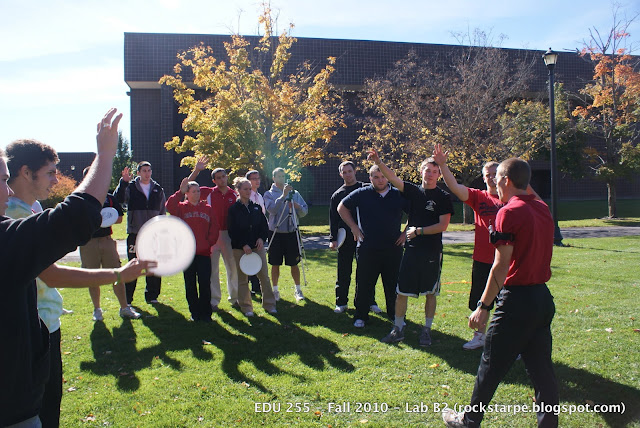
The above video is my fourth time teaching. Right after I was finished teaching my lesson on leading with the backhand pass in ultimate frisbee, I was very disappointed with how it went. I forgot things that I wanted to say just minutes after going over it with Dr. Yang. I seem to always draw a blank as soon as I start my lesson for some reason. I'm optimistic that this occurrence will cease to exist over time. After some time to think it over it didn't go as badly as I thought. One of the problems I put upon myself was my insistence that I incorporate everything on the C-9 form into my lesson. That is one of the reasons why I probably forget things because I try to put too much stuff into my short and simple lesson. Another thing that this affects is my time coding within my lesson. Because I try to incorporate everything on the C-9 form in the short time that I have, I spend too much time instructing and not enough time in activity.
Within my lesson I incorporated the three domains of teaching. The class ran and caught the disc for the psychomotor domain. This would be NYS Learning Standard 1a and NASPE Standard 1. For the cognitive domain, I asked the class to recall the cues to the backhand pass in the beginning of the lesson and to tell me one of the common mistakes while leading a partner with the backhand pass at the end of the lesson. This would fit in NYS Learning Standard 1a as well and NASPE Standard 2. The last domain, the affective domain, was incorporated into the lesson by having the students work in groups of three. They also had to interact while performing the activity. This would fit into NYS Learning Standard 2a and NASPE Standard 5.
The following is a list of things that I incorporated in my lesson:
- Introduction: I introduced myself.
- Hook: I asked how many people had brothers or sisters and then if anyone was an only child. I told the only child that it was their lucky day because we were all going to be brothers and sisters.
- Cues: I had the class think back and recall the cues to the backhand pass.
- Demonstration: I demonstrated what I wanted the students to do.
- Common faults: I told the class some common mistakes when leading a partner with the backhand pass.
- Safety statement: I reminded them to be alert.
- Feedback: I walked around and gave feedback. I provided some general and skill feedback that was congruent to my lesson.
- Checking for understanding: I asked them to tell me a common mistake when leading a partner with the backhand pass.
The following is a list of things that I didn't do well in my lesson:
- Visual aid: I made a visual aid but forgot about it.
- Signal for attention: I didn't tell the class what my signal for attention was.
- Statement of expectation: I didn't provide one.
- Demonstration: I only demonstrated once and not really at full speed.
- Common faults: I didn't demonstrate the common faults, only told the class.
- Feedback: I provided feedback to less than 50% of the class.
Transcription
Time Coding
Feedback Analysis
Sunday, October 10, 2010
SUNY Cortland Mini Conference
I attended the Leadership: The Power to Empower Players session with Kathy Taylor and the Special Olympics Certification Workshop session. I only got to sign into the first one, however, because the second one didn't have a sign in sheet for some reason.
In the Leadership session, Coach Taylor discussed ten tips on developing great team leaders. Some of the tips were to establish a relationship with your players; set goals and write them down; lead with questions and suggestions, not answers; and be a good role model.
In the Special Olympics session, Bill Collins discussed how the Special Olympics work and what has to be done to become a certified coach. Some of the things that he mentioned that I didn't know about was that the special Olympic athletes do train for the sport they participate in. All of the athletes' entry and travel are paid for by the Special Olympics. There are over twenty sports over three seasons as well.
It was an interesting day and definitely worth going to. I look forward to the next conference.
In the Leadership session, Coach Taylor discussed ten tips on developing great team leaders. Some of the tips were to establish a relationship with your players; set goals and write them down; lead with questions and suggestions, not answers; and be a good role model.
In the Special Olympics session, Bill Collins discussed how the Special Olympics work and what has to be done to become a certified coach. Some of the things that he mentioned that I didn't know about was that the special Olympic athletes do train for the sport they participate in. All of the athletes' entry and travel are paid for by the Special Olympics. There are over twenty sports over three seasons as well.
It was an interesting day and definitely worth going to. I look forward to the next conference.
Wednesday, October 6, 2010
Lab B1 Reflection
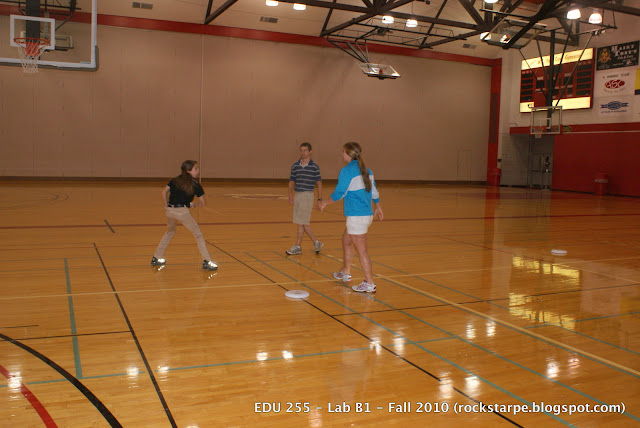
The above video is my third time teaching a four minute lesson in EDU 255. It didn't go as smoothly as my previous lesson. I can make the excuse that I had presentations and work in other classes, but the fact is I need to do a better job on time management when this is the case. Because of my poor time management this time, I had a bad visual aid; I didn't practice as much as I should have; and my lesson wasn't as good as it should have been.
The following is a list of things that I incorporated in my lesson:
- Introduction: introduced myself
- Hook: gave a common scenario in ultimate frisbee and stated how it prevents a team from scoring and doing an endzone dance
- Cues: I established and taught the two cues in my lesson, which were pivot and pass
- Demonstration: I demonstrated what I wanted the students to do. I had a student defending against me and another student waiting for the pass. I performed the cues, pivoted and passed.
- Asked if there were any questions about the activity
- Safety statement: be alert
- I walked around and gave feedback. I reminded them that the challenge was to do two or three pivot moves before passing the frisbee.
- Checking for understanding: I asked them how to recall the pivot cue at the end of the lesson and show me how it is done
- I ended class with an endzone dance and told them we would start our first game next class to get them excited for it.
The following is a list of things that I didn't do well in my lesson:
- Signal for attention:
- Statement about expectation: I tried to throw one in, but it was specific and clear what it was. I said, "By the end of the day we should all be able to do an endzone dance." This went with my hook about not being able to score because of a defender is on you and preventing the team from doing an endzone dance. The statement implied that by the end of the day they should be able to do an endzone dance, which would mean that they learned how to get the pass off around the defender to score. I will have to be more clear on what I expect next time.
- Common faults: I didn't demonstrate of describe any common faults
- Visual aid: my visual aid was small and not colorful
- I turned my back on the class while walking to the visual aid to show them
- A couple students were talking during the lesson, and I didn't ask them to pay attention and stop talking.
- At the end of the lesson when I told everyone to bring it in, two students didn't hear me because they were at the other side of the gym. I didn't take into consideration that the gym space was much larger this time and honestly didn't realize they were all of the way on the other side of the gym.
- I had my watch on, but I forgot all about it. I didn't look at it to see when I started so I didn't have that resource to let me know how much time elapsed and had to kind of guess what was four minutes. The lesson ended up being four minutes, but I need to remember to use my watch next time.
- There was quite a bit of waiting time while everyone was coming back at the end of the activity.
- Update: As I was looking at the feedback analysis form to fill out, I realized that I gave feedback, but I didn't say any names.
Time Coding
Feedback Analysis
Transcription
Thursday, September 23, 2010
Skateboarding added to schools' P.E. curriculum worldwide
Skateboarding added to gym classes
I thought this was interesting to say the least. New and innovating ideas are coming out in PE all of the time. The concept of skateboarding isn't new, but the use of it within a physical education setting is. It could be a fun unit; it definitely will be different than your everyday physical education units.
I thought this was interesting to say the least. New and innovating ideas are coming out in PE all of the time. The concept of skateboarding isn't new, but the use of it within a physical education setting is. It could be a fun unit; it definitely will be different than your everyday physical education units.
Sunday, September 19, 2010
Lab A2 Reflection
The above video is my Lab A2 for EDU 255. I think my second time teaching the four minute lesson went better than the first time. It certainly is a lot easier to teach something when you have practiced it. Even though I practiced it still didn't go exactly how I wrote it out on paper. There were some things that I wanted to say or do that I didn't end up saying or doing. I also went over the four minutes and ended up going for five. I guess it is better to go a little longer than too short though.
The following is a list of things that I incorporated in my lesson:
- Introduction - introduced myself and what I was going to be teaching
- Hook - "When you play basketball how many of you have gotten the ball stolen from you? ... Today I'm going to be teaching you a few drills to prevent that from happening."
- Pinpointing - I had everyone stop and watch Andy doing the drill because he was doing it correctly.
- I asked if everyone understood.
- I set boundaries.
- I repeated the three main points of the lesson while they were playing the game that incorporated them all.
- I gave some specific feedback. I remember telling Jen to get a lower stance.
- Checking for understanding - I asked them what the three main points of the lesson were.
- I used names.
The following is a list of things I should have done in my lesson:
- They took a little long to retrieve a basketball, and I just waited for them. I should have told them to hustle or use a countdown to get them to hurry up. I did tell them to hustle at the end of the game though.
- They started dribbling the ball when I was demonstrating how I wanted it to be done. I should have to hold their basketballs and watch me. When I stopped demonstrating they started to stop doing the drill, and I had to tell them to keeping going. I should have said "Watch me demonstrate how to do it and when I say go I want you to practice the drill."
- I didn't really give specific feedback. I only said "good job" during the drills.
- When I was demonstrating the third drill to rotate until the ball is on the opposite side of the defender I had Andy in front of me so he was blocking me. I should have had Andy in front of me so our sides were facing everyone.
- I didn't mention anything about safety. I originally planned to tell them to be careful not to slap anyone's wrists while playing the game but forgot.
- I kind of just watched as they played the game. I repeated the three main points and gave some feedback but not as much as I should have.
Overall I think I did better than I did the first time so I am happy with how it went but definitely not satisfied.
Subscribe to:
Posts (Atom)